To Celebrating Birth Anniversary of Kim Jong Un
“New Year Seminar on Juche Idea” held in Okinawa
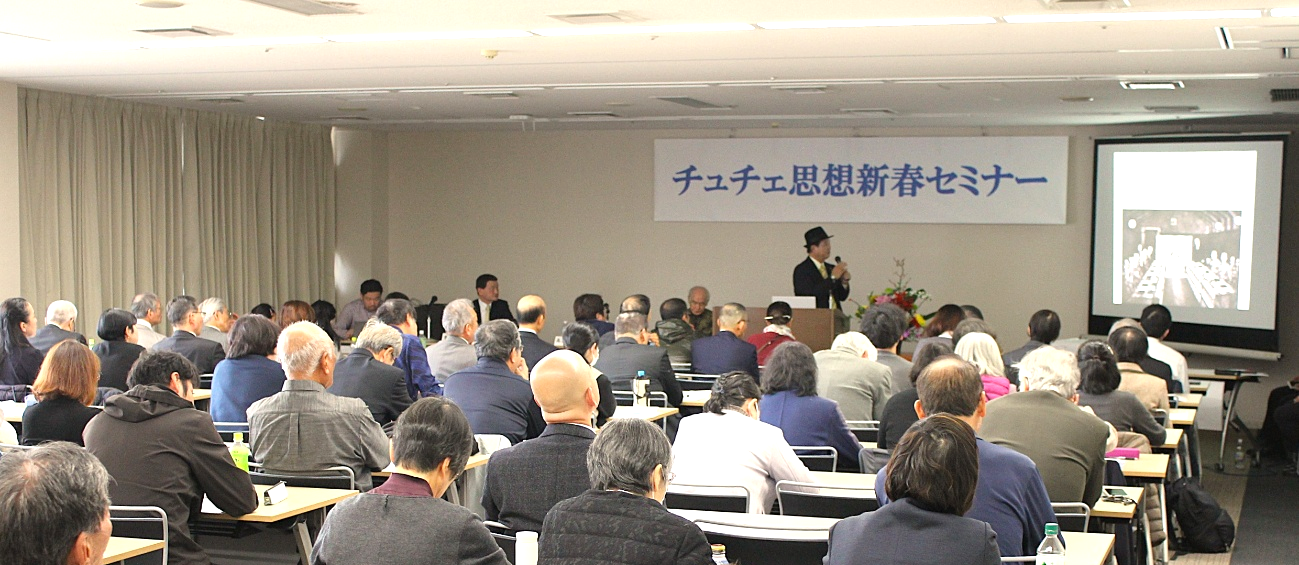
To celebrate the birth anniversary of Kim Jong Un at the start of the new year 2026, a “New Year Seminar on Juche Idea” was held at Okinawa Prefecture Hall for Municipalities on January 10, 2026. It was co-hosted by the Okinawan Liaison Council for the Study of Kimilsung-Kimjongilism and the Japanese National Liaison Council for the Study of Kimilsung-Kimjongilism.
The seminar was attended by Dr. Ogami Ken-ichi, secretary general of the IIJI; Prof. Takara Tetsumi, who was a former Member of the House of Councilors, Prof. Emeritus Nakamura Houshin at Okinawa University and other local scholars, democrats and workers; along with Juche idea researchers from Hokkaido to Okinawa, over 100 in all.
To begin with, a congratulatory message sent by the Korean Association of Social Scientists was introduced.
The message read: “We are confident that your seminar will serve as an important opportunity to further advance the study and dissemination of the Juche idea, and will be a meaningful gathering that further strengthens the bonds of unity among Japan’s progressive forces.”
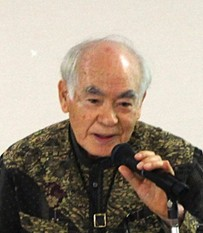
On behalf of the organizers, Prof. Nakamura Houshin gave an address.
Expressing his gratitude to all the Juche idea researchers who had traveled from across the nation to attend the seminar, he hoped that the seminar would become a venue for exchanges filled with human love based on the Juche idea and share people’s desire for peace.
Also, in his speech, Prof. Nakamura specifically referenced respectively the hardships endured by the Ryukyu people and the Korean people, one by one, under the harsh foreign rules.
Describing the deep wounds inflicted on by the battle of Okinawa and the lingering challenges up to now, he stressed that we the people are the driving forces to prevent war and build peace.
Prof. Nakamura concluded his address by expressing his resolve to more actively promote the study and dissemination of the Juche idea in this process of realizing peace, far from supporting war policies.
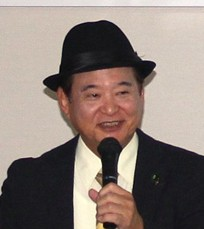
In the seminar, Prof. Emeritus Takara Tetsumi at Okinawa University gave a lecture entitled “80th Anniversary of the Japanese Peace Constitution and Okinawa Now.”
Noting that the year 2026 marks the 80th anniversary of the promulgation of the Constitution of Japan, he pointed out that while Japan observes August 15th as the day marking the end of the war (World War II), it was fundamentally a defeat of Japan, and that this historical understanding has not been sufficiently acknowledged.
Prof. Takara expressed concern that despite the Constitution of Japan clearly stipulating the renunciation of war, the prohibition of conscription, and the three non-nuclear principles, these tenets have been increasingly undermined in recent years. He emphasized that Japan’s defeat led to the enshrinement of a concept of “popular sovereignty” in the Constitution, stressing that each individual must engage in politics as a sovereign citizen. Citing his own action in the past as the sole Diet member to oppose the “resolution condemning the DPRK missile launch,” he spoke of the importance of voicing dissent against injustice, even as a minority at the then time.
Drawing on the experience of the Battle of Okinawa, he stated that to avoid repeating the same mistakes, the Japanese people must continue striving to live in peace.
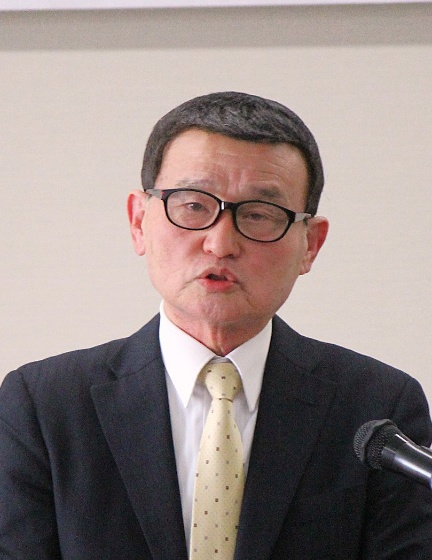
As another lecturer in the seminar, President Ri Yong Su of the Association of Korean Residents’ Social Scientists in Japan, delivered a lecture entitled “DPRK on 80th Founding Anniversary of Workers’ Party of Korea: Shining with Dignity of Socialist Powerhouse.”
He highlighted the significance of his visit to the DPRK in October 2025, covering three key points: the participation in an International Seminar on the Juche Idea, the attendance at the 80th anniversary celebrations of the founding of the WPK, and the exchange of views with his counterparts on important ideo-theoretical issues to confirm the current state of socialist construction in the DPRK and gain a deeper understanding of Kim Jong Un’s revolutionary ideology.
He cited the following three points as the significance of the said seminar:
First, it confirmed from both theoretical and practical perspectives that the Juche idea or the revolutionary ideology of Kim Jong Un is the guiding idea for building a new world, the banner leading the present era, and thus declared the high raising of that banner. Second, it confirmed that the study and dissemination of the Juche idea or the revolutionary theory of Kim Jong Un has transitioned beyond the research stage to a new developmental phase where it is embodied as the strength for practice, and demonstrated the determination of those Juche idea researchers to expand and strengthen their study and dissemination on a global scale. Third, it affirmed that those Juche idea researchers have recognized their role as the “pioneers of the era,” the “propagators of the advanced idea,” and the “forerunners of the world’s struggle for independence,” confirming their new mission.
He also featured the events to commemorate the 80th founding anniversary of the WPK.
Focusing on a series of speeches by Kim Jong Un as the core of the auspicious events, he highlighted three key features as follows:
First, the six speeches by Kim Jong Un were delivered intensively within a short period of time, underscoring the importance of those commemorative events as the foundation for future development. Second, those speeches’ contents spanned politics, the economy, military affairs, and culture, offering original solutions to various issues by dint of the people-first principle. Third, the speeches were forward-looking, not only addressing past and present issues but also outlining future challenges and solutions, presenting new policies and concepts for socialist construction. This clearly demonstrated Kim Jong Un’s resolve to realize an ideal society for the people at an early date.
He then addressed theoretical issues for understanding the current state of socialist construction in the DPRK as well as the essence of Kim Jong Un’s revolutionary ideology.
Regarding the relevant theoretical issues, Mr. Kim Yong Su referred to the content reported on the enlarged meeting of the 13th Plenary Meeting of the 8th Central Committee of the WPK in December 2025. He said:
“The Plenary Meeting emphasized that accelerating the pace of advancement and doubling self-reliance were key achievements in 2025. Then it concluded that these results ensured the successful completion of the five-year plan and established the conditions to confidently advance to the next stage of development. It also stated that the secret to achieving numerous successes in 2025 lay in holding high the banner of ideology, enabling victory through the power of ideology.”
Regarding the key to understanding the ideo-theoretical issues of Kim Jong Un’s revolutionary ideology, he said:
“Kim Jong Un’s revolutionary ideology is, in essence, the people-first principle centered on the idea of one’s devotion to the people, which is an integral system of idea, theory, and method. To internalize the people-first principle as one’s own ideology, it is necessary to have a deep understanding of his outlook on people. It is not just necessary to have a knowledge of Kim Jong Un’s revolutionary ideology but it is crucial for us in terms of what to learn from it and how to put it into practice.
“Kim Jong Un’s outlook on people is centered on the idea of one’s devotion to them is the attitude and stand that is required to regard the people as the master of the revolution, rely on their strength, and serve them with responsibility for their security and livelihood. Regarding the idea of one’s devotion to the people as the guiding principle for practice, a standard for action and an outlook on life, we of Juche idea researchers are requested to digest this ideology until it becomes part of our very being.”
At the conclusion of his lecture, he mentioned that the United States had detained Venezuelan President Nicolas Maduro early in January this year. He accused the US action in that this constituted nothing less than an armed invasion—a military action that clearly violates international law, a criminal act, and state terrorism.
Referring to the fact that the U.S.’s criminal action is now sparking debate under international law, he stated that the U.S. invasion of Venezuela, far from demonstrating American prestige, would instead be an own goal: the action as such would signal the collapse of its moral leadership, alienate progressive peoples worldwide, and deepen the international isolation of the US itself. He said that in conclusion, the year 2026 will be a new year of transformation and change, in which the U.S.-centered world order will completely collapse and global independence will advance significantly.
Emphasizing the importance of persevering for the future, he concluded his lecture by calling for participants to advance together, holding high the Juche idea—the principle aiming for a world of justice and peace.
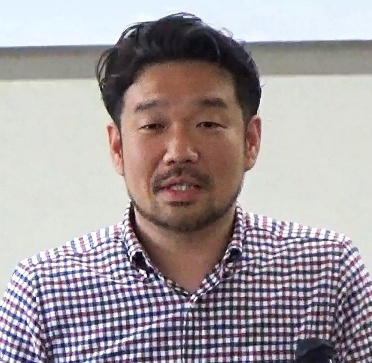
Lawyer Paek Chun, active in Okinawa, summarized the lectures given in the seminar and offered the following closing remarks:
“The DPRK advocates global independence. Participating in this seminar made me keenly aware that independence from the US and achieving global independence are crucial points for us. It strengthened my resolve to strive further for a world where all nations achieve independence.”
The seminar adopted a letter addressed to General Secretary Kim Jong Un.
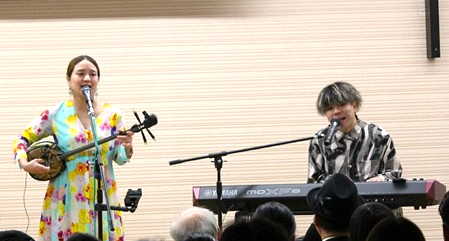
Cultural performances were held, following the seminar.
First, Okinawan musicians Tafuku Mami and Naka Taichiro performed Ryukyu folk songs including “Shimanchu nu Takara (Okinawan Treasure),” evoking the beautiful sceneries of the Okinawan Islands.
Next, Japanese singer Toyama Yoko sang songs including her original one like “Ishiwari-zakura (Blooming cherry tree splitting a stone).”
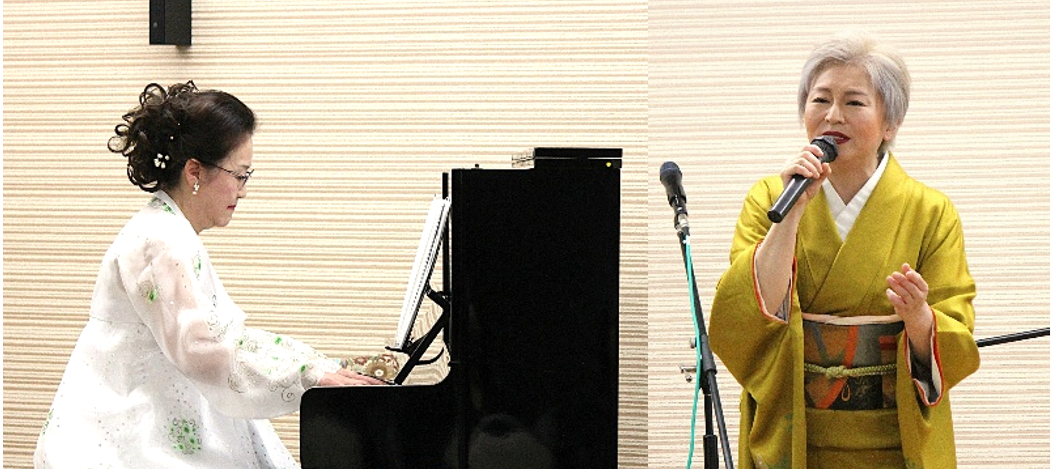
Korean resident’s pianist Kim Jong Suk then performed “Yeongcheon Arirang,” filling the venue with the piano’s beautiful tones.
Kim Jong Suk and Toyama Yoko further presented a stage performance featuring perfectly synchronized piano and vocals.
Responding to the audience’s encore, Toyama Yoko sang a DPRK song “My Country Is the Best” accompanied by Kim Jong Suk on piano.
The New Year Seminar on the Juche Idea became a gathering where every participant renewed their resolve to strive even harder in their work throughout the coming year.